SYMBIOSIS
Symbiosis is a participatory workshop developed and delivered as part of the Living Tree Mirror Maze exhibition at the Egg Theatre. The workshop took place within the main theatre gallery, a richly layered environment combining an indoor ancient woodland with mirrored maze sculptures designed by mathematician Alf Coles in collaboration with Feilden Clegg Bradley Studios.
The workshop invited participants to explore the idea of symbiosis within woodland ecosystems. While nature is often framed through competition, the session instead focused on cooperation, interdependence and mutual benefit—highlighting how the most resilient systems are often those that work together.
The experience began around a single, moss-covered log, rich with lichens and carefully positioned to feel almost animate, like a quiet woodland presence. Participants were encouraged to look closely, using the lichen as a starting point for discussion. Lichens offer a powerful example of symbiosis: they are not a single organism, but a partnership—most commonly between a fungus and algae or cyanobacteria—living, growing and reproducing together as one.
From this intimate observation, the conversation expanded outward to the wider woodland system, touching on mycorrhizal networks and the “wood wide web”: the underground fungal networks that allow trees and plants to communicate, share resources and support one another.
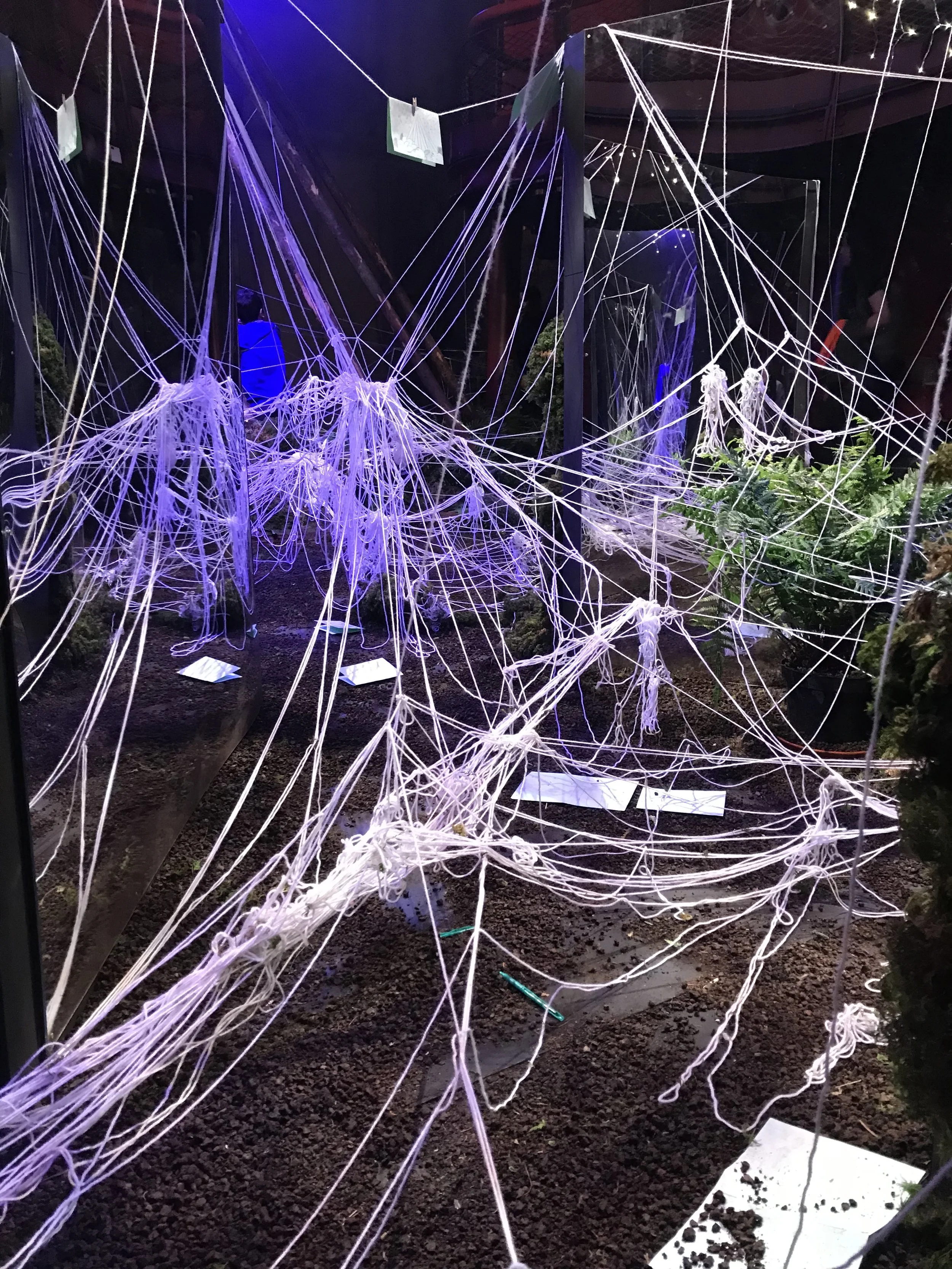
Responding physically to these ideas, participants used white wool to collectively weave a mycorrhizal network throughout the gallery space. The wool was passed from person to person and threaded around the room, gradually forming a visible, web-like structure that echoed the invisible networks beneath a forest floor. As the space filled, movement became collaborative and responsive—when one strand was pulled or brushed, the effect was felt elsewhere, immersing everyone within a shared, living system.
The workshop concluded with drawing, note-making and reflection. Participants added their thoughts directly onto the woven network, arranging ideas in relation to one another and considering how connections form—not just in forests, but between people, ideas and shared experiences.